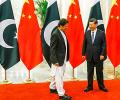
'If a 'two-front war' develops, Iron Brother may only turn out to be a drag on the PLA, since Pakistan is in no position to wage a war with India,' argues Ambassador M K Bhadrakumar.

Both Mahinda Rajapaksa and Modi have learnt from their past mistakes. Modi has understood that Rajapaksa is a 'forever politician' that India has to live with, observes Ambassador M K Bhadrakumar.

Pakistan will not cooperate with the US in Afghanistan unless and until the latter accepts its central role in the search for a settlement and accommodates its 'legitimate interests'. This is the crux of the matter, says MK Bhadrakumar.

'Gotabaya will expect India to observe the red line.' 'He even dispensed with any gesture welcoming India as an interlocutor on the Tamil issue.' points out Ambassador M K Bhadrakumar.
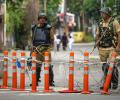
'The heart of the matter is that India is not Israel.'
Indian commentators are inclined to view the country's relations with its neighbours almost exclusively through the prism of the ascendancy of China's diplomacy in South Asia, says M K Bhadrakumar.
Pious pre-summit homilies cannot hide the ugly truth that cooperation in energy security is going at snail's pace despite it being a strategic area for India. The high hopes raised 3 years ago during the visit by Vladimir Putin to Delhi remain unfulfilled, says M K Bhadrakumar.

An opinion is steadily gaining ground in Muslim countries in India's 'extended neighbourhood' that the Modi government is adopting State policies that are decidedly 'anti-Muslim', warns Ambassador M K Bhadrakumar.
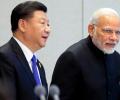
It is apparent that an easing of tensions at the border and a disengagement of troops is on the cards, observes Ambassador M K Bhadrakumar.
Big-power rivalries in the Central Asian region have catapulted Pakistan into a key role in the US's regional strategy more than at any time, says M K Bhadrakumar.

The shift toward a staunchly secular identity will help Congress to rebuild its trust and confidence with the minority communities, especially Muslim voters. Arguably, this is where the Congress' future also lies in national politics, observes M K Bhadrakumar.

'Like everyone else addicted to Kremlin politics, I too have a thesis.' 'Foreign policy is known to be Putin's forte -- and Russia's stability his obsession.' 'As we enter the 2020s, it is clear that an extraordinary turbulent decade lies ahead in world politics and it casts dark shadows on Russia's future,' notes Ambassador M K Bhadrakumar.
The Afghan endgame is moving into a crucial phase. Much will depend on regional politics involving Pakistan, Iran, India and China. How far the US's 'divide-and-rule' strategy succeeds remains to be seen, says M K Bhadrakumar.
As Afghanistan President Hamid Karzai begins his two-day visit to India on Tuesday, policymakers face the challenge to get the Afghan plot straight, says former diplomat M K Bhadrakumar
The close assembly election results in Kerala -- where the CPM is the single largest party but won't form the government -- is thanks only to VS's line, which insists that the primary obligation of the party is not merely toward electoral politics but toward the vast segments of dispossessed, marginalised, humiliated, impoverished people, says MK Bhadrakumar
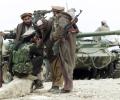
'Washington is well aware that the Haqqani group was responsible for terrorist attacks on the Indian diplomatic establishments in Afghanistan.' 'But today US self-interest dictates that Sirajuddin Haqqani's mainstreaming in Afghan political life and a potential elevation eventually to a leadership role at the national level is useful and necessary, since he can deliver peace,' notes Ambassador M K Bhadrakumar.
Indian foreign policy is listlessly meandering. At times, it stands still lost in thoughts and then it dashes forward -- and the next thing you know, it begins dashing backward. The pantomime seems to be happening with no greater logic than that it creates the illusion of a flurry of activity -- and our PM feels good and dynamic, says M K Bhadrakumar.

Richard Holbrooke, who passed away on Monday, was probably inching toward his complete lifetime achievement -- as the architect of peace in Afghanistan and in South Asia, says M K Bhadrakumar.
Prime Minister Manmohan Singh would have his tete-a-tete with Obama in Bali in a surreal setting, says MK Bhadrakumar, and draws comparisons to the US-China encounter in Honolulu
The US is in desperate need to conjure up an ideology-driven relationship with India, to enable it to boost its arms exports to the Indian market, says M K Bhadrakumar.

'What Kamala Harris' rise and rise underscores is that our old ways of identifying the Indian-American Diaspora need to change...' 'None of this detracts from her Indian-American identity, which makes us feel as if we are Americans too,' notes Ambassador M K Bhadrakumar.
While the United States is unlikely to launch an attack on Pakistan, the US military build-up on the Pak-Afghanistan border is the opening salvo to unfurl a "containment strategy" toward Pakistan, says M K Bhadrakumar

'The sooner Pakistan and India face these geopolitical realities, the better it will be for their own security and prosperity,' observes Ambassador M K Bhadrakumar.

'This is a critical story that Modi seems to grasp far better -- almost instinctively -- in comparison with most of his predecessors as prime ministers,' notes M K Bhadrakumar.
The "uncommitted" Malayali voter today has hardly any political choice available. Even if he were to choose the Congress-led UDF in the polls on April 13, he would be acutely conscious that five years hence he would have no choice but to revert to the communist-led LDF to run the successor government, writes M K Bhadrakumar
In a clutch of ice-cold words Dr Singh conveyed a great deal outright rejecting any third party mediation and disabusing any Pakistani notions to the effect that India was coming under US pressure over the Kashmir issue.
Ustad Abdul Rab Rasul Sayyaf, Afghan president Hamid Karzai's first choice as the speaker of the new Afghan parliament, is at once the perfect bridge the latter needs to reach out extensively in the Islamic world and Pakistan, says former diplomat MK Bhadrakumar, possibly the first and last India to have met Sayyaf in his native village
M K Bhadrakumar, who is in Kerala covering the election, offers his take on how the importance of politics is receding for the average Malayali.

In another 2-3 weeks, coronavirus will chariot India to overtake the United States. In March, Modi had exhorted the nation to celebrate India's impending success over the virus by clanging metal plates. Make no mistake, India is losing this momentous war under his captaincy, notes Ambassador M K Bhadrakumar.
The Headley case highlights that the Indian government proved incapable of assessing the geopolitical dimensions of the US-led war in Afghanistan, while Pakistan has shrewdly exploited the fallacies in India's foreign policy orientation to navigate itself to an unprecedented geopolitical positioning, writes M K Bhadrakumar.

'The Dalai Lama is in a tearing hurry.' 'The 'reincarnation' card remains unplayed, and time is running out.' 'Is something big being planned for the event of Tibetan Buddhist leaders in Leh in November?' asks Ambassador M K Bhadrakumar.
M K Bhadrakmar, the former diplomat and strategic thinker, reviews the first day of President Obama's visit to India.

'Why not simply make some more ventilators and find some more beds? How much would it cost?' asks Ambassador M K Bhadrakumar.
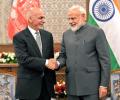
Make no mistake, the Bangladeshi and Afghan missions in Chanakyapuri would report verbatim to their capitals the abrasive remarks attributed to the Indian leadership, casting a slur on their countries' political culture and national honour, warns Ambassador M K Bhadrakumar.

How should one interpret the new bonhomie between the two nations?
M K Bhadrakumar says helping Pakistan with flood relief may help America win some hearts and minds in that country.
In a fashion, his political life may yet be only beginning. Seared by the anguish of the past week's hellish experience, he may henceforth see things and India's political culture in a new, mature perspective. His 'homecoming' may have become complete.
With the agreement over processing of spent nuclear fuel, a major stumbling block for the 'operationalisation' of the Indo-US nuclear deal has been removed
India's options are few. Can it drop its insistence on taking the 26/11 file to its bitter end? No elected government in New Delhi can adopt a policy of 'kiss-and-make-up' on the 26/11 file, given the public mood in the country regarding the horrendous nature of the crime that the ISI perpetrated.
'The overall India-US relationship is entering a mature phase where the two countries can have different perceptions or specific interests with regard to regional or global issues and can still talk about an enduring economic partnership to mutual benefit.'
